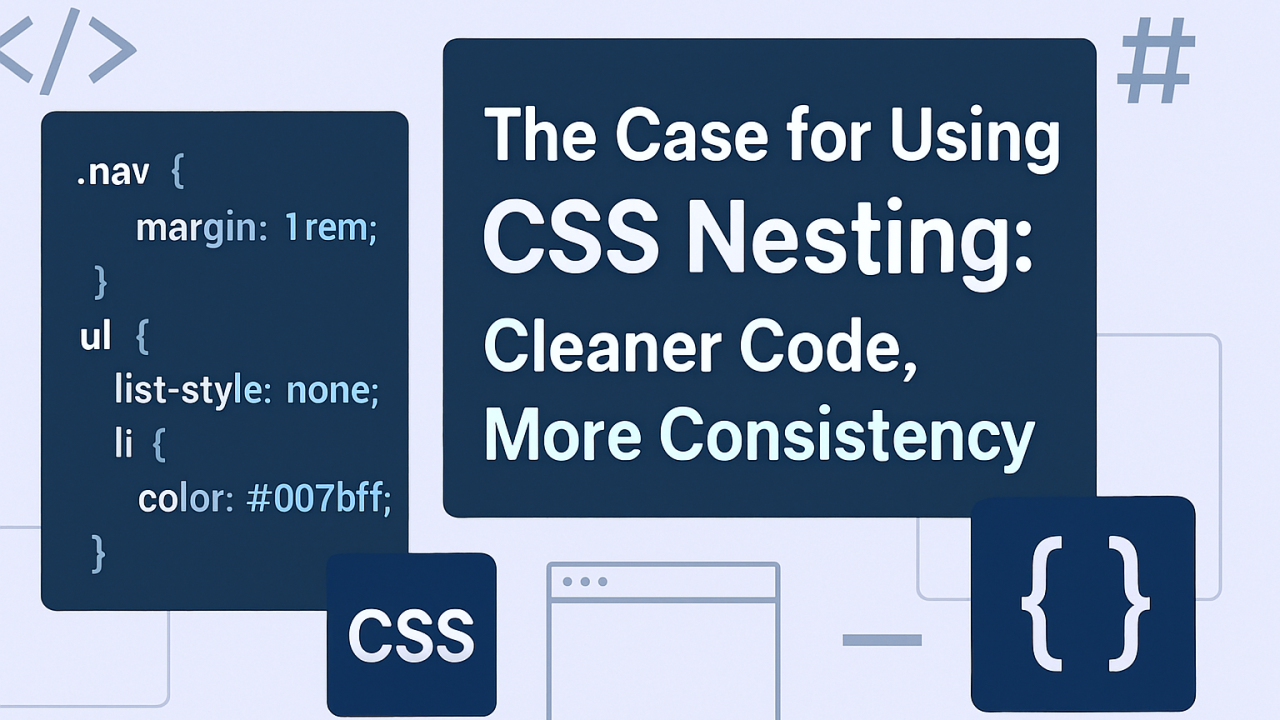
Why Nesting in CSS is Game Changer for Clean, Consistent Code
Keeping stylesheets clean and consistent presents a significant challenge as front-end projects grow. CSS nesting serves not only as a syntactical convenience but also as a practical method for writing better, more organized styles.
It might be time to rethink your approach if you’re still writing flat, repetitive CSS.
1. Nesting Brings Visual Structure
In traditional CSS, we frequently find ourselves repeating selectors merely to define styles for related elements:
.card {}
.card-title {}
.card-content {}
This works, but it’s easy to lose the relationship between elements, especially when styles grow across hundreds of lines.
With nesting:
.card {
  padding: 1rem;

  .card-title {
    font-weight: bold;
  }

  .card-content {
    color: #444;
  }
}
Now the structure is obvious. You see exactly what belongs in ".card" without jumping around. It mirrors how the component is built in HTML.
2. Better Consistency, Fewer Surprises
When styles are nested within their parent scope, it’s harder to accidentally override elements or apply styles globally without being aware of it.
Take a button component, for example:
.button {
  background: blue;

  &:hover {
    background: darkblue;
  }

  &--primary {
    color: white;
  }
}
Everything is grouped logically. You’re not scattering styles for ".button", ".button:hover", and ".button--primary" across the file, they live together. This leads to more consistent patterns and easier maintenance.
Recommended by LinkedIn
3. Less Repetition, More Focus
Nesting helps you stay focused on the component you’re styling. Instead of repeating class names everywhere, you write once and group the rest inside:
.nav-item {
  color: gray;

  &:hover {
    color: black;
  }

  &.active {
    color: blue;
  }
}
It’s readable and keeps your code DRY without relying on extra tools or naming conventions.
4. Don’t Overdo It
Nesting is helpful, but it doesn't permit you to explore too deeply. Avoid repeating your entire DOM in your nesting; it's as messy as using selectors that are too specific. Stop after no more than two or three levels.
Conclusion
Writing less code isn't the goal of nesting. It all comes down to writing in more organized, readable styles that complement the way your components are structured.
Modern browsers are starting to support nesting by default, so there's really no excuse not to utilize it, especially if you're already using SCSS or PostCSS.
#CSS #Frontend #WebDevelopment #CodeStyle #CleanCode #UI #BestPractices


This is a great insight!
💡 Great insight
💡 Great insight
Helpful insight, Rahul
Great insights, Rahul! CSS nesting really does help streamline styles and keep code more organized—especially in component-based projects.