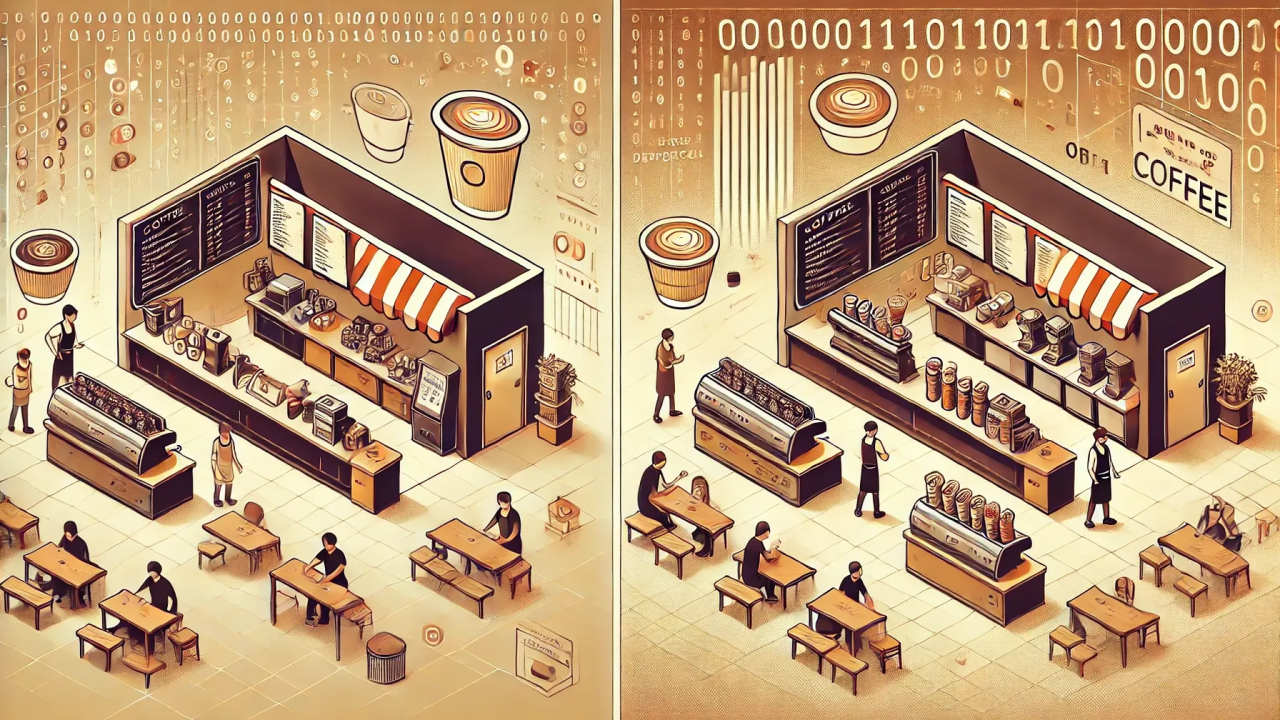
Understanding Asynchronous vs Parallel Programming with Coffee Shops

Understanding Asynchronous vs Parallel Programming with Coffee Shops

Execution time in software systems is often consumed by waiting for I/O operations—commonly referred to as "I/O-bound" operations. "Asynchronous programming" shines in such scenarios by allowing the program to proceed without being "synchronized" to the slow task, effectively managing these waiting periods.

In contrast, "synchronous" programming—often synonymous with "sequential" programming—requires the program to complete all steps in order before moving to another task, even if it means waiting idly. To understand these concepts better, let's dive into a simple analogy involving coffee shops! ☕😊


Concurrent Coffee: Asynchronous Programming in Action

Imagine you and your friend visit a coffee shop. Here's how the process unfolds:

  1. You stand in line while the barista takes orders from others. 👨🚶♂️👩🚶♂️
  2. When it's your turn, you place an order for two fancy coffees. 👉☕☕
  3. The barista communicates with the coffee machine to prepare your drinks and gives you a token for your order. 🎒
  4. While waiting for the coffee, you grab a table and chat with your friend, periodically checking the counter for your token number. 👬🙂
  5. When your token is called, you retrieve the coffee and enjoy your drinks together. 💌☕🌈

Key Takeaways:

  • During the coffee preparation, you're free to focus on another task (talking with your friend). 🤪
  • The process is "asynchronous" because you aren't synchronized with the coffee preparation task. Instead, you switch focus between tasks efficiently. 🔄
  • The barista and coffee machine operate concurrently, optimizing their efforts. 💡


Parallel Coffee: Synchronous Programming Explained

Now, imagine a different scenario:

  1. You visit a coffee shop where each barista also doubles as a coffee machine operator. 👷♂️👷♀️
  2. You wait in line as every customer before you stands at the counter until their coffee is prepared. 🕱
  3. When it’s your turn, the barista takes your order and immediately starts preparing your coffee while you wait at the counter. 🌚
  4. You and your friend are stuck at the counter, unable to do anything else, until the coffee is ready. ⌛😢

Key Takeaways:

  • In this setup, you’re synchronized with the coffee preparation process. 🎡
  • Your attention is entirely dedicated to the task, leaving no room for multitasking (e.g., chatting with your friend). ❌
  • This approach is analogous to "parallelism" where tasks are executed simultaneously but with less flexibility to manage time. 🔀


Concurrency vs Parallelism

Both concurrency and parallelism relate to "multiple things happening simultaneously," but they’re fundamentally different:

  • Concurrency: Efficiently managing multiple tasks by overlapping them. Ideal for I/O-bound operations where waiting is common. 📈
  • Parallelism: Performing multiple tasks at the exact same time, leveraging multiple processors. Best for CPU-bound operations like complex calculations. 🥟


When to Use What? 🔍

Concurrent Programming ⏳

  • Perfect for web applications with many users making simultaneous requests. 🌐
  • Reduces idle time by letting the server handle other tasks while waiting for responses. 🚀

Parallel Programming 🔄

  • Ideal for CPU-intensive tasks like image processing, machine learning, or deep learning, where simultaneous computation is required. 🌟


Combining the Two: The Best of Both Worlds 🌌

With modern frameworks like FastAPI, you can achieve concurrency for I/O-bound tasks and parallelism for CPU-bound workloads. For example:

  • A web server handling multiple user requests concurrently. 🛠️
  • Machine learning models running in parallel to perform heavy computations efficiently. 📊

By blending these techniques, FastAPI provides high performance for web applications, rivaling frameworks like Node.js and Go. ⚡


Final Thoughts 🔄✨

Concurrency and parallelism aren’t competing concepts but complementary tools. While concurrency is better for scenarios involving a lot of waiting, parallelism excels at tasks requiring extensive computation. Understanding their differences and applications allows you to build systems that are both efficient and scalable. 🎮

So, the next time you’re optimizing your application’s performance, think about coffee. Are you multitasking while waiting, or are you working in parallel to clean the house faster? The choice makes all the difference! 💡☕

To view or add a comment, sign in

More articles by Ankit yadav

Others also viewed

Explore content categories