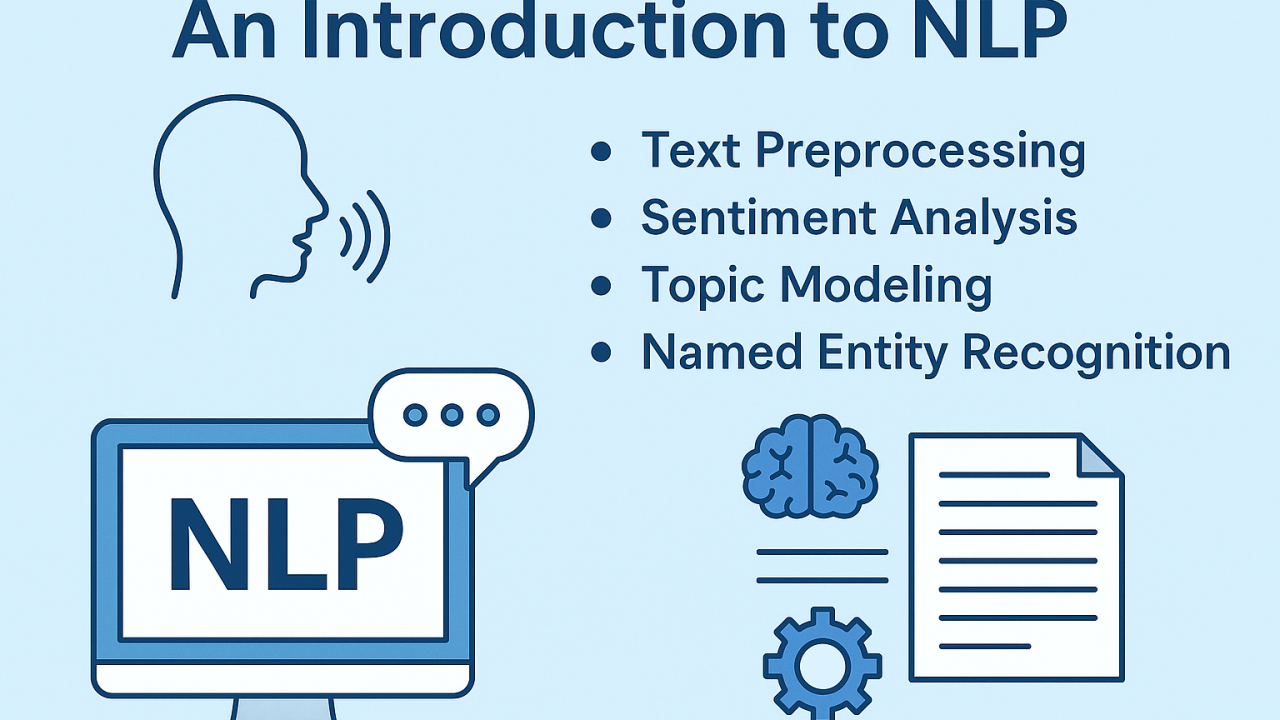
Natural Language Processing and Sentiment Analysis Program
Introduction to NLP
Natural Language Processing (NLP) is a critical branch of artificial intelligence that enables computers to process, understand, and generate human language. With the explosion of digital communication, NLP plays a vital role in making sense of unstructured text data from sources such as emails, news articles, reviews, and social media posts. Applications of NLP are vast, powering systems like virtual assistants, search engines, customer service bots, and healthcare document processing. Understanding the principles behind NLP is foundational to building intelligent systems that interact naturally with humans.
Core NLP Tasks
At its core, NLP focuses on several key tasks. Text classification involves assigning pieces of text to predefined categories, such as tagging emails as spam or non-spam. Sentiment analysis, another major task, seeks to determine the emotional tone of text, categorizing it as positive, negative, or neutral. Named Entity Recognition (NER) extracts structured information such as names of people, organizations, and locations from unstructured text. Machine translation automates the conversion of text between languages, and text generation focuses on summarizing, paraphrasing, or creating new content based on input text.
Data Ingestion and Exploration
The first step in any NLP project is data ingestion. Data can be sourced from CSV files, JSON documents, APIs, or scraped directly from websites. Once loaded into a structured format such as a pandas DataFrame, it is essential to explore the dataset. Exploratory steps include viewing a few rows with head(), understanding the dataset's structure with info(), and generating basic statistical summaries with describe(). During this phase, analysts also check for missing values, inconsistencies, or anomalies that might affect model performance later.
Data Cleaning and Preprocessing
Raw text is often messy and requires cleaning before analysis. Cleaning involves normalizing text by lowercasing it, removing punctuation, and eliminating special characters. Expanding contractions like "don't" to "do not" helps standardize expressions. Tokenization then breaks the text into manageable units, whether words, subwords, or characters. Removing stop words, such as "the" and "is," reduces noise in the data, allowing models to focus on meaningful content. Stemming and lemmatization reduce words to their base forms, which not only helps in shrinking vocabulary size but also improves model performance by treating similar words as equivalent.
Feature Engineering
Feature engineering is the art of creating additional useful features from raw data. In the context of NLP, one can create features based on text length, such as the number of characters, words, or sentences. More sophisticated features include syntactic attributes like the number of nouns and verbs, or semantic features such as the presence of specific keywords or computed sentiment scores. Especially for social media or short-form text, extracting the number of hashtags, mentions, or emoticons can add predictive power to the models. Thoughtful feature engineering is often the difference between an average and an excellent model.
Sentiment Analysis Techniques
One major technique for sentiment analysis is the use of VADER (Valence Aware Dictionary and sEntiment Reasoner). VADER is a rule-based sentiment analysis tool optimized for short, informal text, making it ideal for analyzing tweets, reviews, and comments. It produces scores for positive, negative, neutral sentiments, and a compound score summarizing overall sentiment. A simple programmatic interface through the NLTK library allows rapid deployment of VADER in real-world applications.
In addition to rule-based approaches, machine learning techniques can be used for sentiment analysis. After converting text into numerical features using Bag-of-Words or TF-IDF (Term Frequency-Inverse Document Frequency) methods, models such as Logistic Regression, Random Forests, Support Vector Machines, and Naive Bayes classifiers can predict sentiment labels. Deep learning methods, while more complex, offer even greater accuracy. Techniques such as Word2Vec, GloVe, and FastText allow text to be converted into dense vector representations, which can be fed into Recurrent Neural Networks (RNNs), LSTMs, or Transformer models like BERT for state-of-the-art performance.
Visualization and Exploratory Data Analysis (EDA)
Visualization is essential to gain insights during the early stages of NLP projects. Word clouds provide an intuitive representation of the most frequent words in the corpus. Bar plots and pie charts can illustrate the distribution of sentiment labels, offering a quick sense of class balance. Histograms of tweet lengths or review lengths help understand the typical text size, which can influence model design choices like sequence length truncation or padding strategies.
Recommended by LinkedIn
Model Evaluation Metrics
Evaluating NLP models requires appropriate metrics. Accuracy measures overall correctness but can be misleading in imbalanced datasets. Precision quantifies how many of the items labeled as positive are actually positive, while recall measures how many of the true positives were correctly identified. The F1 score, as the harmonic mean of precision and recall, provides a balanced metric when classes are imbalanced. Confusion matrices visually display the breakdown of correct and incorrect predictions across classes, making them a critical tool for diagnostic analysis.
For text generation tasks such as summarization or translation, additional metrics like BLEU (Bilingual Evaluation Understudy) and ROUGE (Recall-Oriented Understudy for Gisting Evaluation) measure the quality of generated text based on n-gram overlap with reference texts.
Handling Imbalanced Data
A common challenge in real-world sentiment analysis is dealing with imbalanced datasets where one class dominates. Techniques such as oversampling the minority class (e.g., using SMOTE), undersampling the majority class, or adjusting class weights during training can mitigate the imbalance and improve model generalization. Careful analysis and metric selection, particularly focusing on recall and F1-score, are critical when working with skewed data.
Best Practices for Building NLP Pipelines
Building NLP projects requires careful engineering to ensure reproducibility and maintainability. It is recommended to modularize code, writing clean, reusable functions for each step of preprocessing, modeling, and evaluation. Proper documentation, including function docstrings and markdown explanations, is essential, especially when collaborating with others. Setting random seeds ensures reproducibility of results, and saving versions of libraries and models helps maintain consistency across environments.
Optional Extensions
Beyond the basics, several advanced topics can enrich NLP projects. Deploying a sentiment analysis model as a web application using Streamlit or Flask allows users to interact with the model in real-time. For large datasets, distributed processing frameworks like Dask or SparkNLP become invaluable. Building custom sentiment lexicons tailored to a specific domain can improve rule-based models. Finally, explainability tools such as LIME and SHAP can demystify machine learning predictions, offering transparency critical in sensitive applications like healthcare and finance.
Here's the game:
Conclusion
Natural Language Processing and sentiment analysis represent powerful tools for extracting value from text data. Mastering the full pipeline—from data ingestion to visualization, modeling, evaluation, and deployment—prepares practitioners to build impactful, production-ready NLP systems. Tools like NLTK and VADER offer an accessible starting point, while more advanced techniques like deep learning open doors to the frontier of human-like language understanding.
START
  ↓
Data Ingestion
  → Load CSV/JSON/API data
  → Inspect data (head, info, describe)
  ↓
Data Cleaning
  → Normalize text (lowercase, remove punctuation)
  → Expand contractions
  ↓
Text Preprocessing
  → Tokenize text
  → Remove stop words
  → Stem or Lemmatize
  ↓
Feature Engineering
  → Extract features (length, hashtags, emojis)
  ↓
Sentiment Analysis
  → Apply VADER Sentiment Analyzer
  → (Optional) Train ML Model (Logistic Regression, Random Forest, SVM)
  ↓
Visualization
  → Word clouds
  → Sentiment distributions
  ↓
Model Evaluation
  → Accuracy, Precision, Recall, F1-score
  → Confusion matrix
  ↓
(Optionally) Advanced Topics
  → Deep learning models (LSTM, BERT)
  → Deployment (Streamlit app)
  ↓
END


The best read for beginners
Amazing work Michael Lively . Let's use this for next hackathon