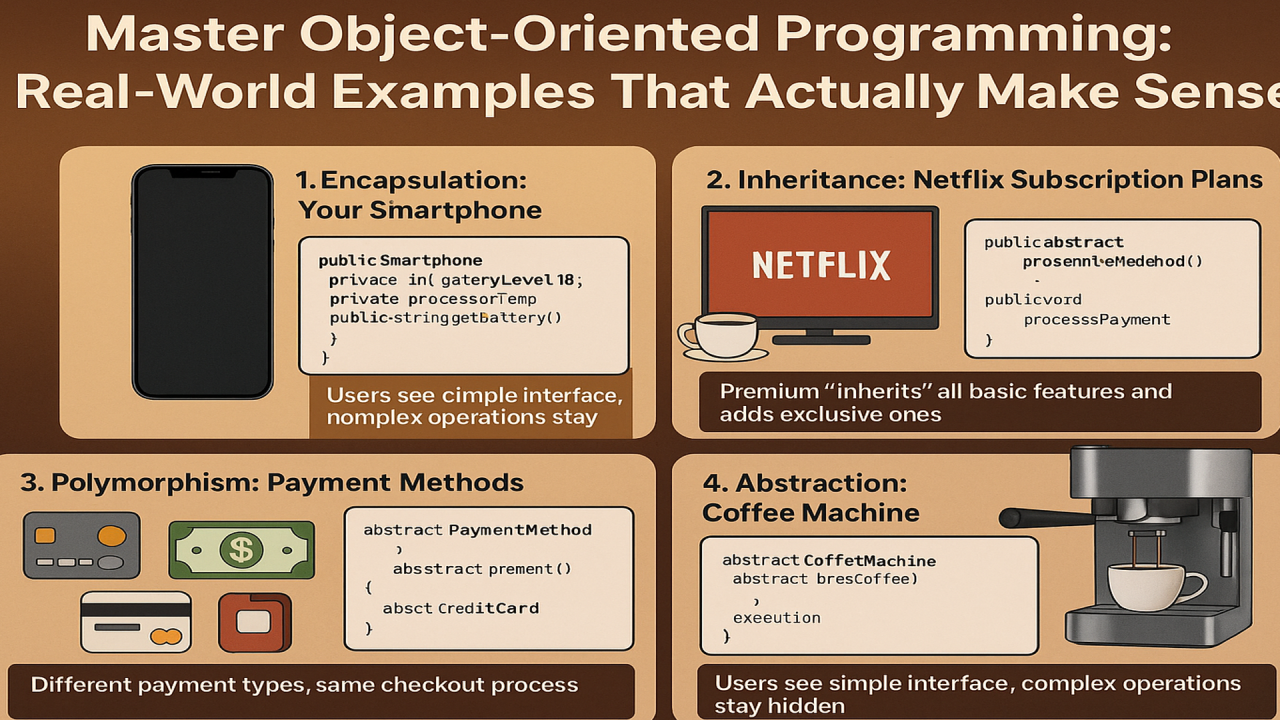
Master Object-Oriented Programming: Real-World Examples That Actually Make Sense!
Stop struggling with abstract OOP concepts. Here's how everyday objects teach us programming fundamentals.
Why OOP Feels Complicated (And How to Fix It)
Most developers learn OOP through boring examples like "Animal" classes and "Car" hierarchies. But here's the secret: OOP mirrors how we naturally think about the world around us.
Let me show you the four pillars of OOP using examples you encounter every day.
🔐 1. Encapsulation: Your Smartphone
Real Life: Your phone has internal components (battery, processor, memory) that you can't directly access. You interact through the interface (touchscreen, buttons).
In Java:
public class Smartphone {
    private int batteryLevel = 100;     // Private attribute
    private int processorTemp = 35;     // Hidden from user

    public String getBatteryLevel() {   // Public method
        return "Battery: " + batteryLevel + "%";
    }

    public void chargePhone() {
        batteryLevel = Math.min(100, batteryLevel + 10);
    }
}
Key Insight: Users don't need to know how the battery charging algorithm works—they just plug in the charger.
🧬 2. Inheritance: Netflix Subscription Plans
Real Life: Netflix has Basic, Standard, and Premium plans. All share common features (streaming, account access) but have different capabilities.
In Java:
class NetflixPlan {
    protected double price;

    public NetflixPlan(double price) {
        this.price = price;
    }

    public String streamContent() {
        return "Streaming available";
    }

    public String manageAccount() {
        return "Account management enabled";
    }
}

class PremiumPlan extends NetflixPlan {
    public PremiumPlan() {
        super(17.99);
    }

    public String downloadContent() {
        return "Downloads available";
    }

    public String ultraHdStreaming() {
        return "4K streaming enabled";
    }
}
Key Insight: Premium "inherits" all basic features and adds exclusive ones.
🎭 3. Polymorphism: Payment Methods
Real Life: Whether you pay with cash, credit card, or digital wallet, the cashier processes your payment the same way.
In Java:
abstract class PaymentMethod {
    public abstract String processPayment(double amount);
}

class CreditCard extends PaymentMethod {
    @Override
    public String processPayment(double amount) {
        return "Charging $" + amount + " to credit card";
    }
}

class DigitalWallet extends PaymentMethod {
    @Override
    public String processPayment(double amount) {
        return "Deducting $" + amount + " from wallet balance";
    }
}

class Cash extends PaymentMethod {
    @Override
    public String processPayment(double amount) {
        return "Received $" + amount + " in cash";
    }
}

// Same interface, different implementations
public class Checkout {
    public static String processCheckout(PaymentMethod paymentMethod, double amount) {
        return paymentMethod.processPayment(amount);
    }
}
Key Insight: Different payment types, same checkout process.
🏗️ 4. Abstraction: Coffee Machine
Real Life: You press "Espresso" and get coffee. You don't need to understand the grinding, heating, and pressure systems inside.
In Java:
abstract class CoffeeMachine {
    public abstract String brewCoffee();

    public void serveCoffee(String coffeeType) {
        System.out.println("Preparing " + coffeeType + "...");
        String coffee = brewCoffee();
        System.out.println("Your " + coffeeType + " is ready!");
    }
}

class EspressoMachine extends CoffeeMachine {
    @Override
    public String brewCoffee() {
        // Complex brewing logic hidden
        grindBeans();
        heatWater();
        applyPressure();
        return "Rich espresso shot";
    }

    private void grindBeans() {
        // Hidden complexity
    }

    private void heatWater() {
        // Hidden complexity
    }

    private void applyPressure() {
        // Hidden complexity
    }
}
Key Insight: Users see simple interface, complex operations stay hidden.
🎯 Real-World Application: Building a Social Media App
Let's combine all concepts:
java
import java.util.*;

abstract class SocialMediaUser {
    protected String username;
    private List<String> privateMessages;  // Encapsulation

    public SocialMediaUser(String username) {
        this.username = username;
        this.privateMessages = new ArrayList<>();
    }

    public abstract String createPost();  // Abstraction

    public String getUsername() {
        return username;
    }
}

class RegularUser extends SocialMediaUser {  // Inheritance
    public RegularUser(String username) {
        super(username);
    }

    @Override
    public String createPost() {
        return "Created text post";
    }
}

class InfluencerUser extends SocialMediaUser {  // Inheritance
    public InfluencerUser(String username) {
        super(username);
    }

    @Override
    public String createPost() {
        return "Created sponsored post";
    }

    public String monetizeContent() {
        return "Earnings calculated";
    }
}

// Polymorphism in action
public class SocialMediaApp {
    public static void displayFeed(List<SocialMediaUser> users) {
        for (SocialMediaUser user : users) {
            System.out.println(user.getUsername() + ": " + user.createPost());
        }
    }
}