How does the Python interpreter work?
@author: Siva Velivelli
How does the Python interpreter work?
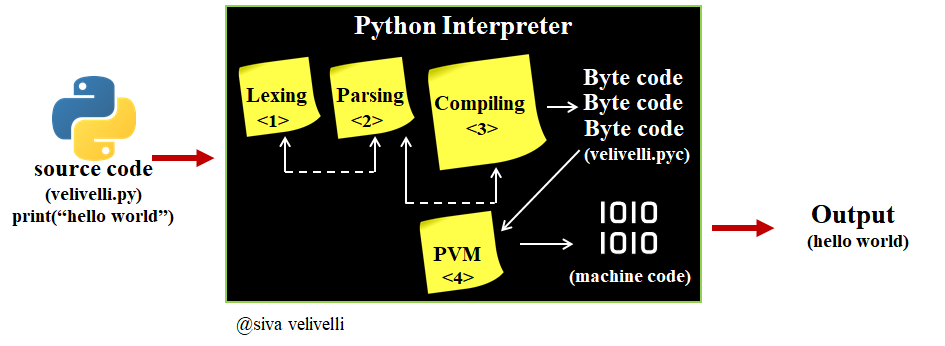
● When we run source code (a file with a .py extension), the lexer (a component of the Python interpreter) divides the line of code into tokens (a process known as lexing).
● The parser (another component of the Python interpreter) uses these tokens to construct a structure called an "Abstract Syntax Tree", which depicts the relationship between these tokens (a process known as parsing).
● If an error occurs during the parsing stage, the Python interpreter will stop the translation and display an error message (syntax error).
● If no errors are found, the compiler (another Python interpreter component) converts the Abstract Syntax Tree into intermediate language code, also known as byte code (a compiled version is known as byte code).
● This byte code is saved in a file called ".pyc," which is the same as the name of the source code file.
● Bytecode is a platform-independent representation of source code at a low level.
● The Python Virtual Machine (PVM) (another Python interpreter component) loads the bytecode (along with the inputs and library modules) into the Python runtime and converts it to machine-executable code (0's and 1's in binary).
● It displays an error message if an error occurs (a runtime error). It prints the output if no errors occur during execution.