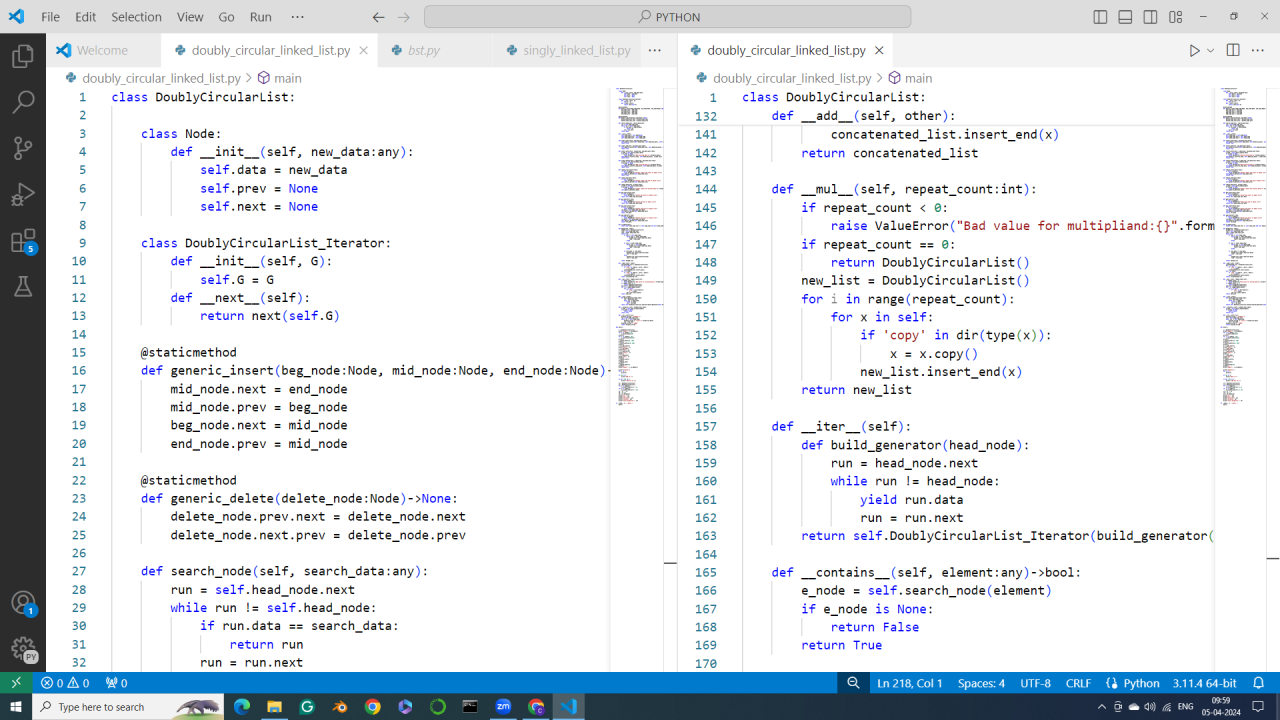
How to design a data structure neatly using Python OOP features?
Difficulty Level: Upper Intermediate.
Audience: Anyone who knows one OOP language and has implemented a linked list.
Source Code: Given at the end for reference.
Abstract: Anybody who has worked with a traditional OOP language such as C++ or Java is in for the culture shock while learning Python. Because Python does not have a static keyword, Python does not even have access specifiers viz. 'private', 'public' and 'protected'. Python class and object is simply a collection of attribute names and their associated object which are subjected to change at run time! But Python has extensive support for operator overloading, also, Python has built-in support for design patterns such as decorator. Python scope, visibility model is flexible enough to be able to write a class under another class or a class under another function. This small article illustrates how can we use these mechanisms to better structure our code. The logic of the linked list is not explained. Only design decisions behind using Python features and how it helps further our cause are explained. The complete source code is given at the end for the reference.
Recommended by LinkedIn
Regarding the code given at the end:
The Source Code:
class DoublyCircularList:

    class Node:
        def __init__(self, new_data:any):
            self.data = new_data
            self.prev = None
            self.next = None

    class DoublyCircularList_Iterator:
        def __init__(self, G):
            self.G = G
        def __next__(self):
            return next(self.G)

    @staticmethod
    def generic_insert(beg_node:Node, mid_node:Node, end_node:Node)->None:
        mid_node.next = end_node
        mid_node.prev = beg_node
        beg_node.next = mid_node
        end_node.prev = mid_node

    @staticmethod
    def generic_delete(delete_node:Node)->None:
        delete_node.prev.next = delete_node.next
        delete_node.next.prev = delete_node.prev

    def search_node(self, search_data:any):
        run = self.head_node.next
        while run != self.head_node:
            if run.data == search_data:
                return run
            run = run.next
        return None

    def __init__(self):
        self.head_node = self.Node(None)
        self.head_node.prev = self.head_node
        self.head_node.next = self.head_node

    def insert_start(self, new_data:any)->bool:
        self.generic_insert(self.head_node, self.Node(new_data), self.head_node.next)
        return True

    def insert_end(self, new_data:any)->bool:
        self.generic_insert(self.head_node.prev, self.Node(new_data), self.head_node)
        return True

    def insert_after(self, e_data:any, new_data:any)->bool:
        e_node = self.search_node(e_data)
        if e_node is None:
            raise ValueError("Bad existing data:{}".format(e_data))
        self.generic_insert(e_node, self.Node(new_data), e_node.next)
        return True

    def insert_before(self, e_data:any, new_data:any)->bool:
        e_node = self.search_node(e_data)
        if e_node is None:
            raise ValueError("Bad existing data:{}".format(e_data))
        self.generic_insert(e_node.prev, self.Node(new_data), e_node)
        return True

    def remove_start(self)->bool:
        if self.is_empty():
            raise ValueError("Cannot remove the start of empty list")
        self.generic_delete(self.head_node.next)
        return True

    def remove_end(self)->bool:
        if self.is_empty():
            raise ValueError("Cannot remove the end of empty list")
        self.generic_delete(self.head_node.prev)

    def remove_data(self, d_data)->bool:
        e_node = self.search_node(d_data)
        if e_node is None:
            raise ValueError("Cannot remove non existen data:{}".format(d_data))
        self.generic_delete(e_node)

    def get_start(self)->any:
        if self.is_empty():
            raise ValueError("Cannot get_start of empty list")
        return self.head_node.next.data

    def get_end(self)->any:
        if self.is_empty():
            raise ValueError("Cannot get_end of empty list")
        return self.head_node.prev.data

    def pop_start(self)->any:
        if self.is_empty():
            raise ValueError("Cannot pop_start of empty list")
        ret_data = self.head_node.next.data
        self.generic_delete(self.head_node.next)
        return ret_data

    def pop_end(self)->any:
        if self.is_empty():
            raise ValueError("Cannot get_start of empty list")
        ret_data = self.head_node.prev.data
        self.generic_delete(self.head_node.prev)
        return ret_data

    def is_empty(self):
        return self.head_node.next == self.head_node and self.head_node.prev == self.head_node

    def merge(self, other):
        merged_list = DoublyCircularList()
        run1 = self.head_node.next
        run2 = other.head_node.next
        while True:
            if run1 == self.head_node:
                while run2 != other.head_node:
                    merged_list.insert_end(run2.data)
                    run2 = run2.next
                break

            if run2 == other.head_node:
                while run1 != self.head_node:
                    merged_list.insert_end(run1.data)
                    run1 = run1.next
                break

            if run1.data <= run2.data:
                merged_list.insert_end(run1.data)
                run1 = run1.next
            else:
                merged_list.insert_end(run2.data)
                run2 = run2.next

        return merged_list

    def __add__(self, other):
        concatenated_list = DoublyCircularList()
        for x in self:
            if 'copy' in type(x).__dict__.keys():
                x = x.copy()
            concatenated_list.insert_end(x)
        for x in other:
            if 'copy' in type(x).__dict__.keys():
                x = x.copy()
            concatenated_list.insert_end(x)
        return concatenated_list

    def __mul__(self, repeat_count:int):
        if repeat_count < 0:
            raise ValueError("Bad value for multipliand:{}".format(repeat_count))
        if repeat_count == 0:
            return DoublyCircularList()
        new_list = DoublyCircularList()
        for i in range(repeat_count):
            for x in self:
                if 'copy' in dir(type(x)):
                    x = x.copy()
                new_list.insert_end(x)
        return new_list

    def __len__(self) -> int:
        n = 0
        run = self.head_node.next
        while run != self.head_node:
            n += 1
            run = run.next
        return n

    def __iter__(self):
        def build_generator(head_node):
            run = head_node.next
            while run != self.head_node:
                yield run.data
                run = run.next
        return self.DoublyCircularList_Iterator(build_generator(self.head_node))

    def __contains__(self, element:any)->bool:
        e_node = self.search_node(element)
        if e_node is None:
            return False
        return True

    def __str__(self)->str:
        display_string = "[START]<->"
        run = self.head_node.next
        while run != self.head_node:
            display_string += "[{}]<->".format(run.data)
            run = run.next
        display_string += "[END]"
        return display_string

def main():

    L = DoublyCircularList()
    print("empty:", L.is_empty())
    for x in range(1, 6):
        L.insert_end(x*10)
    print(L)
    for x in range(6, 10):
        L.insert_start(x*10)
    print(L)
    L.insert_after(10, 100)
    print(L)
    L.insert_before(10, 200)
    print(L)
    x = L.get_start()
    print("start:", x)
    x = L.get_end()
    print("end:", x)
    x = L.pop_start()
    print("start:", x)
    print(L)
    x = L.pop_end()
    print("end:", x)
    print(L)
    L.remove_start()
    print(L)
    L.remove_end()
    print(L)
    L.remove_data(10)
    print(L)
    print("empty:", L.is_empty())

    print("Iterate:")
    for x in L:
        print(x)

    if 100 in L:
        print("100 in L")

    if not -100 in L:
        print("-100 not in L")

    L1 = DoublyCircularList()
    L2 = DoublyCircularList()
    for x in range(5):
        L1.insert_end((x+1) * 5)
    for x in range(7):
        L2.insert_end((x+1) * 10)
    L3 = L1  + L2
    L4 = L1 * 5
    L5 = L1.merge(L2)
    print("L1:", L1)
    print("L2:", L2)
    print("L3=L1+L2:", L3)
    print("L4=L1*5", L4)
    print("L5=L1.merge(L2):", L5)

if __name__ == '__main__':
    main()