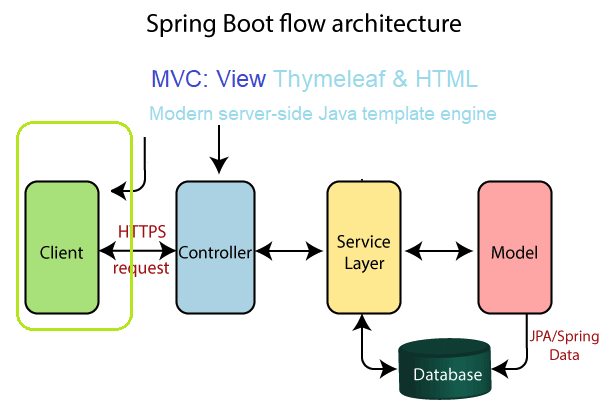
Spring Boot is a popular framework that simplifies building Java applications, particularly web apps and microservices. Part of the larger Spring ecosystem, it focuses on providing a streamlined development experience by minimizing boilerplate code and offering production-ready configurations right out of the box.
- Speed and Simplicity: Spring Boot reduces the setup time with built-in configurations.
- Production-Ready Features: Includes health checks, metrics, and logging for better management.
- Embedded Servers: No need for external servers, as Spring Boot apps can run directly from an embedded Tomcat, Jetty, or Undertow server.
- Robust Ecosystem: Integrates easily with Spring projects like Spring Data and Spring Security.
- Community and Resources: Spring Boot has a strong community and great documentation, making learning and troubleshooting easier.
Features Of Spring Boot
Auto-Configuration
- Spring Boot automatically configures application settings based on the dependencies in your project. For instance, if you include a database dependency, Spring Boot will set up a default database connection, saving significant configuration time.
Embedded Servers
- Spring Boot applications come with embedded servers like Tomcat, Jetty, or Undertow, allowing your application to run independently. This eliminates the need to deploy WAR files to external servers and makes deployment simpler and faster.
Production-Ready Tools
- Spring Boot includes a wide range of production-ready features, such as health checks, metrics, application logging, and monitoring with Spring Boot Actuator. These tools provide real-time insights into application health and performance.
Spring Boot CLI (Command-Line Interface)
- The Spring Boot CLI is a command-line tool that helps in developing Spring applications using Groovy. It allows you to write Spring Boot applications quickly without needing full configurations, making it great for prototyping.
Simplified Dependency Management
- Spring Boot includes a curated list of dependencies called starters that simplify adding common dependencies like Spring Data, Spring Security, and Spring MVC. These starters bring in all required dependencies with compatible versions, reducing conflicts and setup time.
Spring Boot Actuator
- Actuator provides endpoints to monitor and manage applications by exposing metrics, health checks, and environment details. It can be easily integrated with monitoring tools like Prometheus or Grafana for enhanced observability.
Externalized Configuration
- With Spring Boot, configurations are externalized through properties files (application.properties or application.yml), environment variables, and command-line arguments. This flexibility makes it easy to set different configurations for various environments (development, testing, production).
Spring Data Integration
- Spring Boot simplifies database access with Spring Data JPA, making it easy to interact with relational databases. With Spring Data, you can create repositories with minimal code and leverage Spring’s powerful ORM features.
RESTful API Development
- With annotations like @RestController and @RequestMapping, Spring Boot enables rapid development of REST APIs. Its features simplify request handling, making Spring Boot a popular choice for building microservices and RESTful services.
Security and Authentication
- Spring Boot integrates with Spring Security, providing built-in support for securing applications. It enables features like authentication, authorization, and protection against common security threats with minimal configuration.
Testing Support
- Spring Boot includes extensive testing support for both unit and integration tests. It offers annotations like @SpringBootTest, @MockBean, and @WebMvcTest to set up testing contexts easily, ensuring reliable testing coverage.
Flexible Deployment Options
- Spring Boot applications can be packaged as JAR files and deployed independently, which is ideal for cloud-based environments. It also integrates with Docker, Kubernetes, and cloud services like AWS and Azure, making it highly adaptable to various deployment strategies.