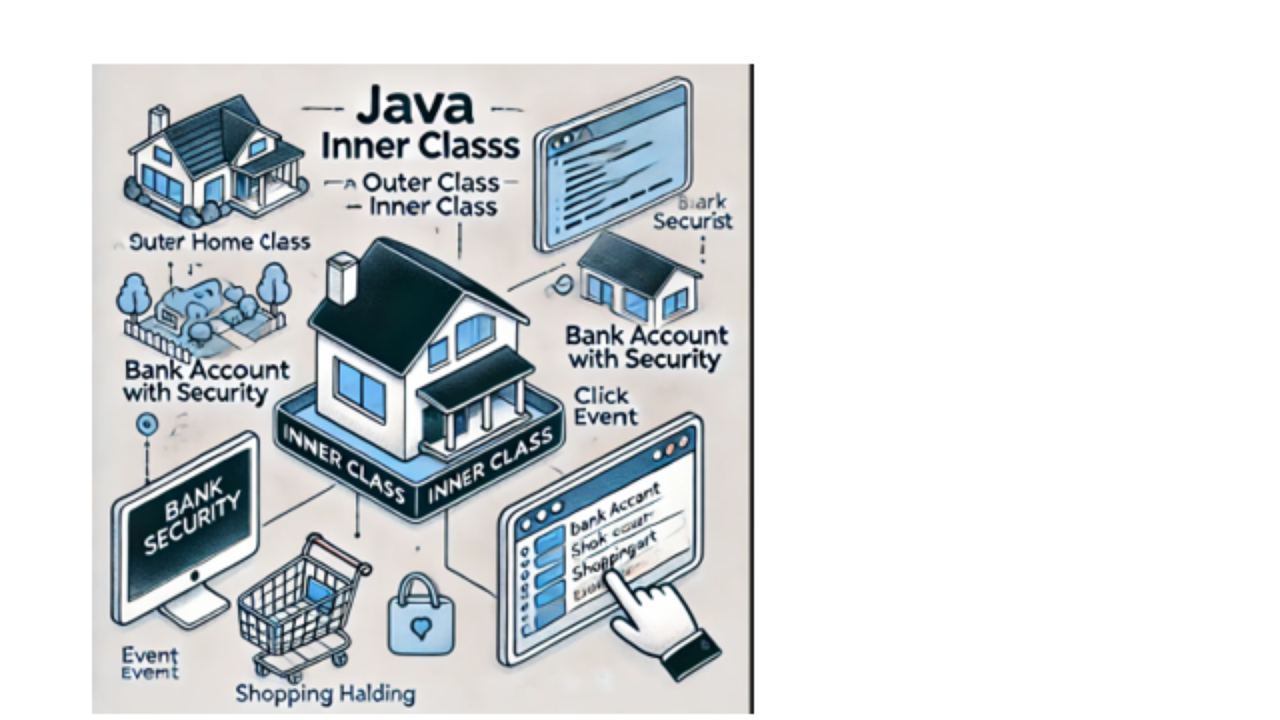
Exploring Java Inner Classes
#JavaInnerClasses #Programming #SoftwareDevelopment#TechEducation
Java Inner Classes
Java inner classes provide a powerful way to logically group classes that are used only in one place, improving encapsulation and readability. They help developers create more structured and maintainable code. This article explores the concept of Java inner classes with engaging real-world examples.
What are Java Inner Classes?
An inner class is a class defined within another class. Java provides four types of inner classes: 1. Member Inner Class
2. Static Nested Class
3. Local Inner Class
4. Anonymous Inner Class
1. Member Inner Class
A Member Inner Class is a class defined inside another class but outside of any method. It can access all fields and methods of the outer class, including private members.
EX:
class House {
private String houseName = "Dream Home";
class Room {
private String roomName;
Room(String name) {
this.roomName = name;
}
void displayInfo() {
System.out.println("House: " + houseName + ", Room: " + roomName);
}
}
public static void main(String[] args) {
House house = new House();
House.Room livingRoom = house.new Room("Living Room");
livingRoom.displayInfo();
}
}
In this example, the Room class is defined inside the House class. A "Room" object can access the private field "houseName" from the " House class."
2. Static Nested Class
A Static Nested Class is a class defined inside another class with the static keyword. It doesn’t need an instance of the outer class to be created. It’s often used when the inner class doesn’t need to access the instance variables of the outer class.
EX:
class BankAccount {
static class Security {
static void authenticateUser(String user) {
System.out.println(user + " authenticated successfully.");
}
}
public static void main(String[] args) {
BankAccount.Security.authenticateUser("John Doe");
}
}
Here, the Security class is a static nested class, and it doesn’t need an instance of "BankAccount "to authenticate the user.
3. Local Inner Class
A Local Inner Class is a class defined within a method. It can be used to implement temporary functionality that doesn’t need to be reused elsewhere.
EX:
Recommended by LinkedIn
class ShoppingCart {
void applyDiscount(double price) {
class Discount {
double calculate() {
return price * 0.9;
}
}
Discount discount = new Discount();
System.out.println("Discounted Price: " + discount.calculate());
}
public static void main(String[] args) {
ShoppingCart cart = new ShoppingCart();
cart.applyDiscount(100);
}
}
In this example, the Discount class is defined inside the " applyDiscount" method. It’s only used in this method to calculate a discount.
4. Anonymous Inner Class
An Anonymous Inner Class is a class without a name. It is used for short-lived functionality, often for event handling. It's defined at the point of instantiation and is commonly used in GUI applications.
EX:
import javax.swing.*;
import java.awt.event.*;
class ButtonClickDemo {
public static void main(String[] args) {
JFrame frame = new JFrame("Button Click Example");
JButton button = new JButton("Click Me");
button.addActionListener(new ActionListener() {
public void actionPerformed(ActionEvent e) {
System.out.println("Button clicked!");
}
});
frame.add(button);
frame.setSize(200, 200);
frame.setDefaultCloseOperation(JFrame.EXIT_ON_CLOSE);
frame.setVisible(true);
}
}
Here, an anonymous inner class defines the button's ActionListener. It’s a short and temporary class that handles the button-click event.
Benefits of Inner Classes
o Encapsulation: Inner classes help keep related functionality together, making the code more organized.
o Improved Readability: By grouping related logic, the code becomes easier to manage.
o Efficient Event Handling: Inner classes, especially anonymous inner classes, make event handling in GUI applications more concise.
o Logical Grouping: Prevents unnecessary clutter by isolating related logic inside the outer class.
Conclusion
Java inner classes provide an elegant way to organize your code. Whether you're building a smart home system, a bank account security system, or creating event-driven applications, inner classes can help make your code more structured and easier to understand.
By understanding and using inner classes, developers can write cleaner, more maintainable Java programs.
#java
#KDU