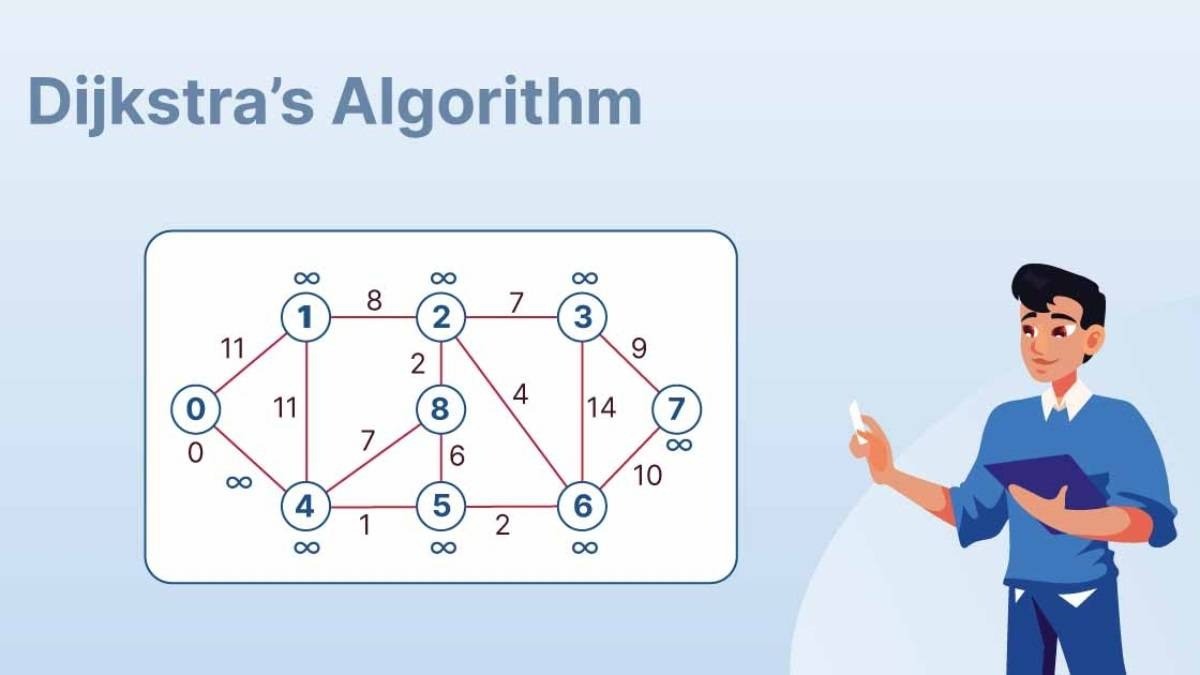
🚀 Dijkstra’s Algorithm – Mastering the Art of Finding the Shortest Path

🚀 Dijkstra’s Algorithm – Mastering the Art of Finding the Shortest Path

In many real-world scenarios, whether it’s navigating city streets, optimizing network routing, or planning logistics routes, finding the most efficient path is essential. Dijkstra’s Algorithm is one of the most popular methods for solving the shortest path problem in a weighted graph with non-negative edge weights. Let’s break it down step by step in a way that’s both intuitive and powerful.

🔍 What Is Dijkstra’s Algorithm?

Dijkstra’s Algorithm provides a way to calculate the shortest distance from a single source vertex to every other vertex in a graph. It’s built on two main ideas:

  1. Greedy Approach: At each step, choose the vertex with the smallest currently known distance from the source.
  2. Relaxation Process: Update the distances of the adjacent vertices of the current vertex. If a shorter path is found, the distance is updated.

By repeating these steps until all vertices have been processed, Dijkstra’s Algorithm ensures that the shortest path to each vertex is found.

🛠️ How Does It Work? – Step-by-Step

Imagine you’re planning a trip from your home (source) to multiple landmarks (destinations) across a city. Each road has a distance (or cost), and you want to know the shortest route to every destination.

Step 1: Initialization

  • Distances Array: Set the distance to the source vertex as 0 and to all other vertices as infinity (∞) since they are initially unreachable.
  • Visited Set: Keep track of processed vertices to avoid reprocessing.

Example: For a graph with vertices A, B, C, D and A as the source:

Initial Distances:

  • A = 0
  • B = ∞
  • C = ∞
  • D = ∞

Step 2: Selecting the Nearest Vertex

  • Pick the Unvisited Vertex with the Smallest Distance: Start with the source (A, distance 0).

Step 3: Relaxation – Update Neighbor Distances

For the chosen vertex, examine each neighbor and calculate the tentative distance from the source by adding the edge weight. If this new distance is smaller than the current distance stored for that neighbor, update it.

  • Example Update: If the edge from A to B has weight 4, set B’s distance to 4 (if 0 + 4 Repeat for all neighbors.

Step 4: Mark the Vertex as Visited and Repeat

  • Once all neighbors are updated, mark the current vertex as visited.
  • Then, select the next unvisited vertex with the smallest distance and repeat the process.

Continue these steps until all vertices have been visited. The distances array will then contain the shortest distance from the source to each vertex.

📊 Visual Representation

Imagine a simple graph with four vertices and the following weighted edges:

Article content

  • Vertices: A, B, C, D
  • Edges & Weights:

  • A → B: 4
  • A → C: 2
  • A → D: 5
  • C → D: 1

Process Outline:

  1. Initialization:Distances: A=0, B=∞, C=∞, D=∞
  2. Start at A (distance 0):Update B: 0 + 4 = 4 Update C: 0 + 2 = 2 Update D: 0 + 5 = 5 Distances become: A=0, B=4, C=2, D=5
  3. Select the Next Vertex:Choose C (smallest distance, 2)
  4. From C:Check edge C → D: 2 + 1 = 3 (smaller than D’s current 5). Update D: Now D=3 Distances update: A=0, B=4, C=2, D=3
  5. Continue with D:From D, if any neighbors remain unvisited, update if necessary (here, all are already visited or have shorter paths).
  6. Final Distances:

  • A: 0, B: 4, C: 2, D: 3

This elegant progression shows how Dijkstra’s Algorithm efficiently finds the shortest path from A to every other vertex.

🌍 Real-World Applications

  • Navigation Systems: GPS and online maps use Dijkstra’s Algorithm to compute the shortest or fastest route between locations.
  • Network Routing: In computer networks, routers utilize the algorithm to determine the optimal path for data packets.
  • Logistics and Transportation: Efficiently planning delivery routes and supply chain management.
  • Social Networks: Discovering the “degrees of separation” between individuals or recommending connections.

💬 Key Takeaways

  • Simplicity & Efficiency: Dijkstra’s Algorithm uses a greedy strategy combined with relaxation, guaranteeing the shortest path in graphs with non-negative weights.
  • Real-Time Impact: Its applications span from everyday navigation to critical network infrastructure, making it a cornerstone algorithm in computer science.
  • Step-By-Step Clarity: The process of initializing distances, updating neighbor values, and iteratively selecting the next closest vertex is both logical and scalable.

How have you applied Dijkstra’s Algorithm in your projects? Let’s discuss more on optimizations, tailor-made implementations, or any challenges you’ve faced while finding the shortest path in complex networks. Feel free to share your insights and experiences in the comments, or reach out for a deeper discussion on graph algorithms!

#GraphAlgorithms #DijkstrasAlgorithm #ShortestPath #Programming #SoftwareDevelopment #TechInsights #Algorithms #DataStructures #CommunityLearning

To view or add a comment, sign in

More articles by Sivachandran A

Others also viewed

Explore content categories