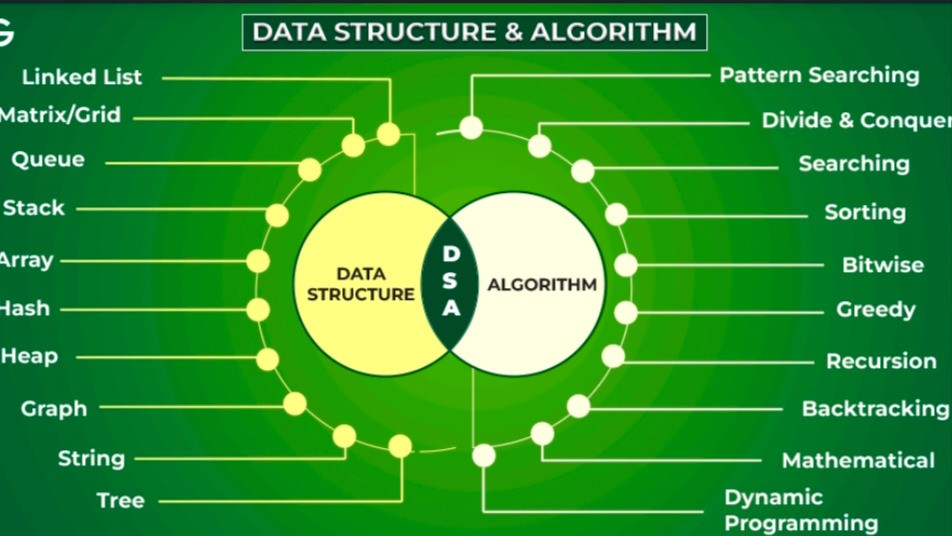
DATA STRUCTURE AND ALGORITHMS
#snsinstitutions #snsdesignthinkers #designthinking
Data structures and algorithms are fundamental concepts in computer science and programming that help in organizing and processing data efficiently.
Data Structures: A data structure is a way of organizing and storing data so that it can be accessed and modified efficiently. Different data structures are suited to different kinds of applications, and some are highly specialized to specific tasks. Here are some common data structures:
1. Arrays: A collection of elements identified by index or key. Arrays are fixed-size and provide constant-time access to elements.
2. Linked Lists: A linear collection of elements where each element points to the next. This structure allows for efficient insertions and deletions.
3. Stacks: A collection that follows the Last In, First Out (LIFO) principle. Operations are mainly `push` (add an item) and `pop` (remove an item).
4. Queues: A collection that follows the First In, First Out (FIFO) principle. Common operations are `enqueue` (add an item) and `dequeue` (remove an item).
5. Trees:A hierarchical structure with a root value and subtrees of children, represented as a set of linked nodes. Binary trees and binary search trees (BSTs) are common examples.
6. Graphs: A set of nodes (vertices) connected by edges. Graphs can be directed or undirected and are used to represent networks.
Recommended by LinkedIn
7. Hash Tables: A data structure that provides fast insertion, deletion, and lookup by using a hash function to compute an index into an array of buckets or slots.
8. Heaps: A specialized tree-based data structure that satisfies the heap property, used primarily in implementing priority queues.
Algorithms Algorithms are step-by-step procedures or formulas for solving problems. They are typically categorized based on their approach or the problems they solve. Some common algorithms include:
1. Sorting Algorithms: Algorithms to arrange elements in a particular order (ascending or descending). - Examples: Quick Sort, Merge Sort, Bubble Sort, Insertion Sort, Selection Sort, and Heap Sort.
2. Searching Algorithms: Algorithms to find specific elements or items in a data structure. - Examples: Linear Search, Binary Search.
3. Graph Algorithms: Algorithms that solve problems related to graph theory, like finding the shortest path or spanning tree. - Examples: Dijkstra's Algorithm, Breadth-First Search (BFS), Depth-First Search (DFS), Kruskal's Algorithm, Prim's Algorithm.
4. Dynamic Programming: A method for solving complex problems by breaking them down into simpler subproblems, storing the results of these subproblems to avoid redundant computations. - Examples: Fibonacci sequence, Knapsack problem, Longest Common Subsequence (LCS).
5. Greedy Algorithms: Algorithms that make the locally optimal choice at each step, hoping to find the global optimum. - Examples: Huffman Coding, Dijkstra’s Algorithm (can be considered


Love your work in web development! Design thinking is so important. Let's connect and share ideas! 🤝