Convening Conversational Space - The CS Facilitation Framework
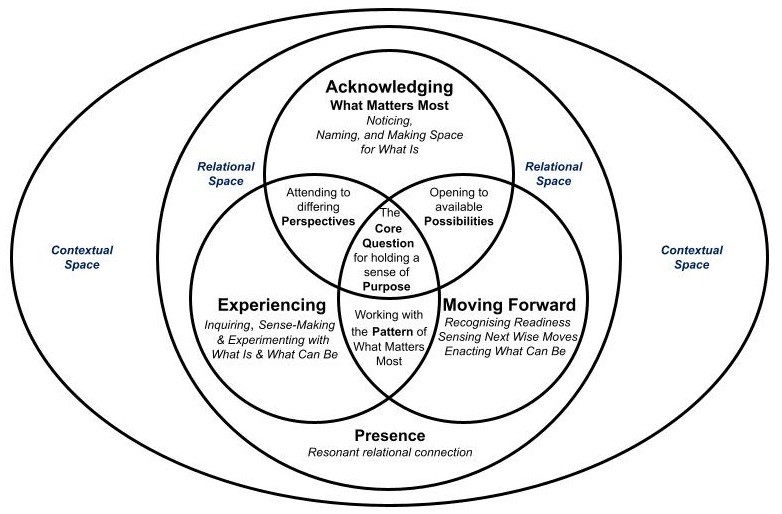
This is a supplementary piece of writing in relation to other articles I've published on conversational spaces. In this one I take one of the newer iterations of the Conversational Spaces Framework (as highlighted in the graphic above) and adjust it slightly so as it can be used as a facilitation framework when working with groups. The rest of the piece then explores each of the elements of the framework and suggests some accompanying questions that can be used when working with groups around their topic of inquiry and what matters most.
This article in particular explores the framework as an approach to working intentionally with a group to support their capacity to move forward in relation to what matters most in their work. However, from experience, the framework can also be used as a set of systemic, contextual, relational and dialogic orienting principles, inquiry points and areas of focus when the facilitator's role is more around helping teams or groups explore stuck patterns, difficult experiences and what might need to be included and attended to in relation to some of the systemic and contextual factors that affect peoples' ability to truly move forward in their work.
What Matters Most - The Core Question for Holding a Sense of Purpose
The notion of ‘What Matters Most’ lies at the heart of the CS Facilitation Approach - it speaks to the core of the work people are involved in, answering the question ‘why do I do this work in the first place?’
Agreeing a Core Question in relation to what matters most provides the energy, intention and purpose for your inquiry - it is what you consistently orient back to as things proceed. This initial inquiry can be done with the group as a whole as an integral aspect of the overall inquiry process - with a concomitant willingness to accept some messiness before a sense of coherence emerges - or, prior to the inquiry with an initial core group, generating potential questions and areas of focus that can then be tested with a wider group of those participating for sense of 'fitness' in relation to what people feel to be most important in their work.
Facilitator Questions for Exploring What Matters Most and agreeing a Core Question:
Element 2 - Conversational Spaces - Acknowledging, Experiencing, Moving Forward
In relation to the core question and to what matters most, Acknowledging is characterised by making space to notice, name and attend to ‘what is' as is.
We begin by acknowledging and attending to current reality and what that brings us into contact with as we take time to sit with what this invites into awareness. This is a space for bringing regard and bearing witness to what is evoked when we support people to properly attend to what matters most and to the core questions at the heart of doing important work; this is a space that enables people to name and recognise their achievements, recognise what it has taken to get this far, reflect on what this signifies, and map out current assets, abilities and potential.
Some Example Facilitator Questions for Acknowledging:
In relation to the core question and to what matters most, Experiencing is characterised by inquiry, sense-making and experimenting with our understanding and experience of ‘what is’ and ‘what can be’
A space for exploring, trying ideas out and ‘on for fit’, and for finding a sense of 'what can be' as it arises from (or alongside) 'what currently is'. Here we are invited to deepen into the shared inquiry and bring our willingness to listen so as to seek to understand the ideas, perspectives and differences of others in the group - to more fully make room for diverse and divergent possibilities as an essential part of taking steps to moving forward together.
Some Example Facilitator Questions for Experiencing:
In relation to the core question and to what matters most, Moving Forward is characterised by recognising readiness (for change), agreeing next wise moves and enacting ‘what can be’.
A space that supports us to more fully and pragmatically connect the past and present (what is) to an experience of movement and momentum in the future (what can be), and that seeks to link what’s available to what’s potential and possible. Taking time to explore what people are ready to do here and now as a precursor to individually and collectively sensing into next wise moves is a crucial part of moving forward coherently.
Some Example Facilitator Questions for Moving Forward:
Element 3 - Three Supporting Factors to attend to when Facilitating in Conversational Space
Recommended by LinkedIn
Alongside the core question and the three conversational spaces, it also helps to explore three other elements when working with groups - attending to and making use of diverse perspectives, opening up to available possibilities (out of all that has potential) and working with the pattern of what matters most
Some Example Facilitator Questions for the Three Supporting Factors:
Element 4 - Working Live in Relational Space
The elements covered so far take place within the wider relational space of the facilitator and group working together, the generativity of which is connected to:
Some Example Facilitator Questions for Working Live in Relational Space:
Element 5 - Attending Thoughtfully to Contextual Space
Finally, all of the elements covered so far are located within a wider contextual space that includes:
Some Example Facilitator Questions for Attending Thoughtfully to Contextual Space:
Whilst the pattern of this article has followed a movement from centre (core question) to periphery (contextual space) I'd want to acknowledge that this is simply a way of structuring the writing around the Conversational Spaces Facilitation Framework. In practice, we are intimately connecting into, attending to (intentionally or unawares), responding to and responding into the contextual and relational spaces that inform, shape, guide and at times contain and constrain the energetic usefulness of the conversational spaces we enter into. Therefore the questions we can hold, inquire into and seek to move forward with which intimately relate to contextual and relational space are always and already present from the start (well, even before the start) of the inquiry itself.
As such, they can be held and referenced as we move from the initial inquiry into what matters most to acknowledging, experiencing, attending to perspective, pattern and possibility, and seeking to move forward. If our inquiries together can sensitively and usefully attend to the relational and contextual aspects of our situations and experiences we might have a better chance of influencing change that is in service of the system as a whole, and thus more likely to offer an experience of generativity, relevance, coherence and 'right fittedness'.
Conclusion
I'm hoping this use of Conversational Spaces as an approach to facilitating groups has value and also provides some interesting ways of attending to dialogue, experimentation and movement in group work processes.
Finally, I'd also want to suggest that Story Space Work can be used as a particular type of organising structure for hosting developmental and exploratory team and group dialogues when working within the wider frame of the Conversational Spaces Facilitation Framework too. This additional level of exploration can support deeply generative team and group working patterns to emerge and then become central to the way a team or group develops together over time, providing a coherent way of working with individual and collective identity, purpose, meaning, interaction, change and outcome achievement.
Gareth
References:
Kahane, A. (2021) Facilitating Breakthrough: How to remove obstacles, bridge differences and move forward together, Oakland: Berrett-Koehler Publishers
Nations, M., Holladay, R. (2013) ''Generative Engagement: Beyond cultural sensitivity" in Eoyang, G., Holladay, R. (2013) Adaptive Action: Leveraging uncertainty in your organisation, Stanford: Stanford Business Books
Thanks for sharing this Gareth 👏🏻
Thanks for sharing, Gareth Evans - I need to catch up on a couple of your articles about CS. Thanks for continuing to keep me updated
Really useful, Gareth; and a beautifully simple diagram!
This looks really helpful Gareth.